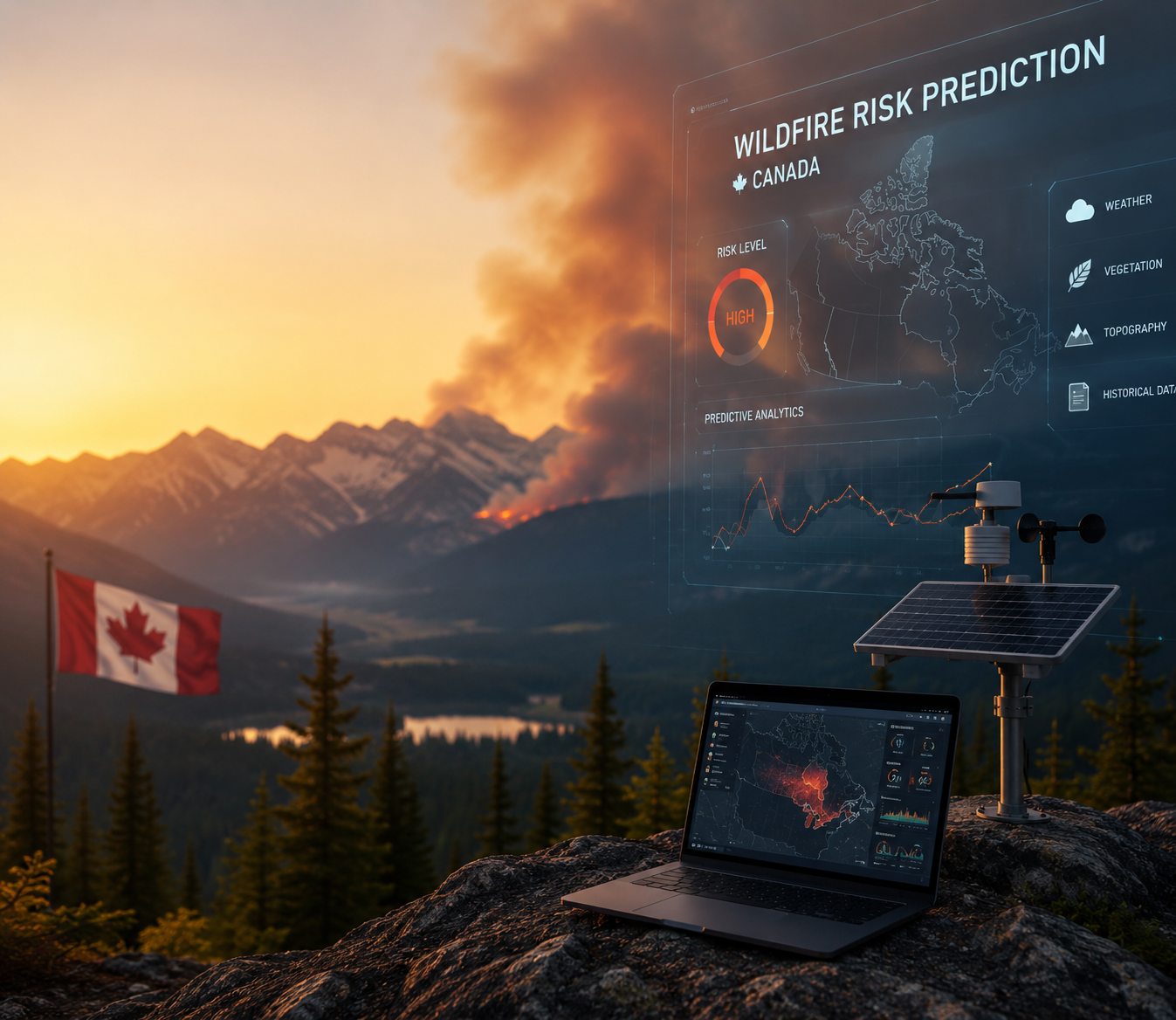
LeoSpark is an AI driven wildfire risk prediction system designed to help identify wildfire prone conditions using environmental, geospatial, and historical fire data.
LeoSpark explores how artificial intelligence and machine learning can support proactive wildfire management by analyzing environmental, geospatial, weather, and historical wildfire data, with a primary focus on Canada.
Identifies conditions associated with elevated wildfire risk using weather patterns, vegetation conditions, terrain, and historical wildfire activity.
Explores Random Forest and other machine learning approaches to better understand wildfire risk patterns and improve predictive accuracy..
Uses Canadian wildfire datasets and environmental data sources to support regionally relevant wildfire risk analysis.
A multi-stage machine learning workflow for understanding and predicting wildfire risk using environmental and historical fire data.
Gathering wildfire, environmental, weather, terrain, vegetation, and satellite derived datasets, with an emphasis on Canadian wildfire conditions.
Cleaning, organizing, and transforming multi-source datasets into structured formats suitable for machine learning and wildfire risk analysis.
Training and evaluating Random Forest to identify wildfire risk patterns and improve predictive performance.
Generating wildfire risk predictions and interactive visual outputs to support wildfire awareness, preparedness, and future decision support systems.
A collaborative research effort between student and faculty at Athabasca University.

Full Professor and Associate Dean, Research & Innovation at Faculty of Science and Technology, Athabasca University, Canada. He is IEEE Senior Member.

Master of Science in Computing and Information Systems student at Athabasca University, focused on AI driven wildfire risk prediction to support smarter wildfire management. He is IEEE Student Member.
Explore the evolving LeoSpark prototype for wildfire risk prediction and visualization.
Demo video coming soon